Security officer vs. security guard: What’s the difference?
The security officer vs. security guard question sounds like it should have a clean answer. Search for security services or read a few job postings and you’ll run into both titles. Some companies use them for different positions. Others use them for the same job. So, is there a real difference?
Usually, no. The U.S. Bureau of Labor Statistics says security guards are also called security officers, and O*NET lists both among the reported job titles for the same occupation. An employer may reserve “security officer” for a lead or more experienced role, but the title alone doesn’t tell you what the person is trained, licensed, or assigned to do.
Security officer vs. security guard: a quick comparison
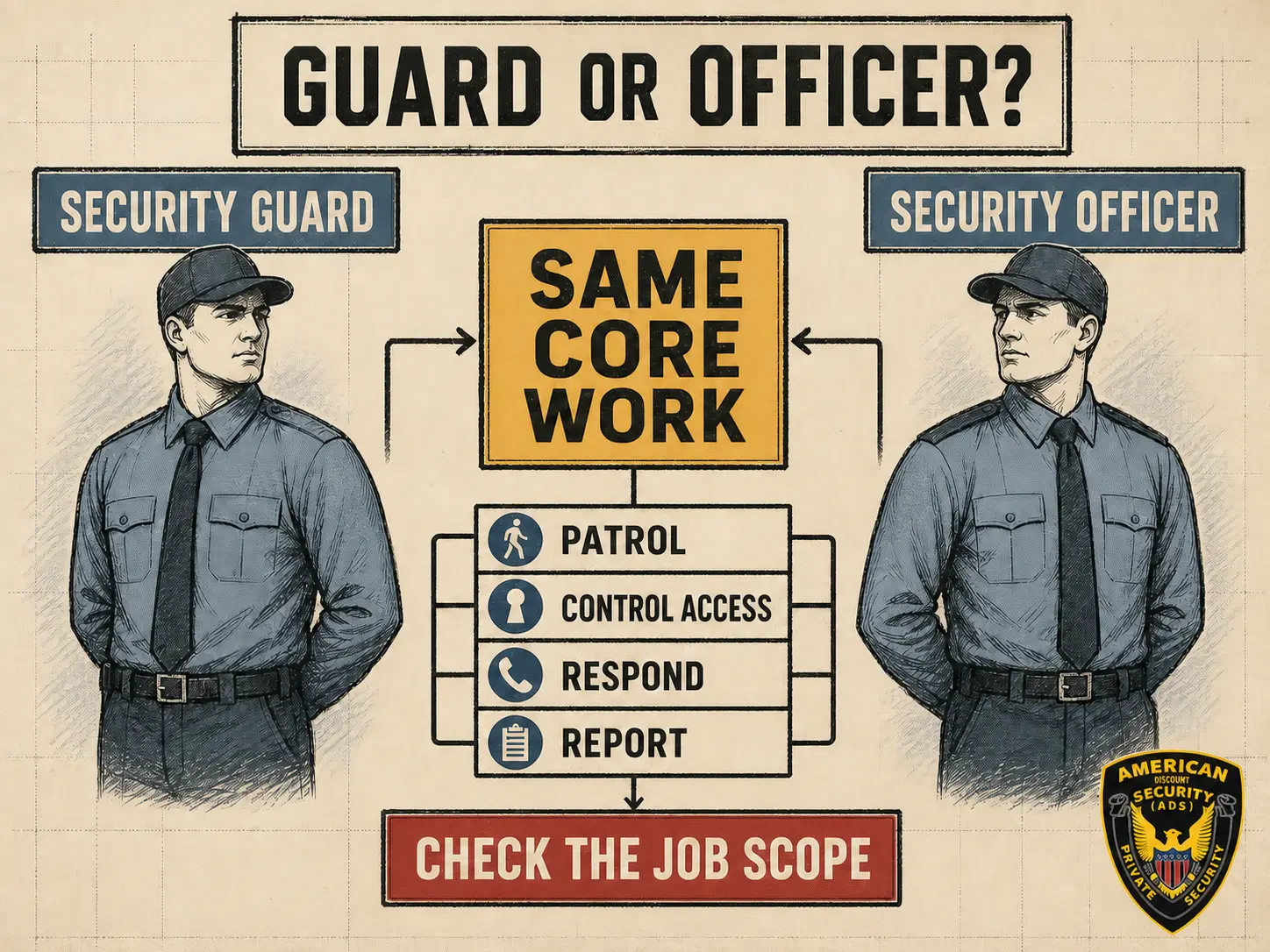
| Question | Security guard | Security officer |
|---|---|---|
| Is it a separate occupation nationwide? | No. It is the standard government occupational term. | Usually no. It is often another title for the same occupation. |
| Typical use of the title | A front-line position assigned to a post, patrol route, entrance, or monitoring station. | Sometimes used for a lead, specialized, or client-facing position. |
| Usual duties | Patrols, access control, observation, incident response, and reporting. | Often the same duties, with possible added coordination or supervisory work. |
| Does the title prove more authority? | No. | No. Authority comes from law, licensing, company policy, and the assignment. |
| Does the title mean armed or unarmed? | No. | No. Armed status requires the proper permits and an armed assignment. |
When you compare proposals or job descriptions, the scope of work matters more than the name on the uniform.
Why the two titles overlap
There is no nationwide rule that makes every security officer senior to every security guard. In fact, the U.S. Bureau of Labor Statistics describes security guards as “also called security officers.” Its standard list of duties includes patrolling property, monitoring alarms and video systems, controlling access, responding to emergencies, enforcing property rules, and writing reports.
O*NET’s profile for security guards lists Armed Security Officer, Campus Security Officer, Hotel Security Officer, Security Agent, Security Guard, and Security Officer under the same occupational code.
That doesn’t mean every employer treats the titles identically. A company may call its entry-level staff guards and its shift leads officers. Another may call everyone a security officer because that is the title used in its contracts and uniforms. A hospital might use “public safety officer,” while a hotel uses “security officer” for a person doing many of the same core tasks.
Those are workplace naming choices, not a reliable national ranking system.
What both roles usually do
The daily assignment depends on the property, but most guard and officer positions pull from the same group of responsibilities.
Control access
Security staff may check credentials, verify visitors, manage sign-in procedures, watch vehicle entrances, and prevent unauthorized access. At a busy office, this can involve regular contact with employees, vendors, and guests. At a construction site, it may mean checking gates and confirming who is permitted to remove equipment.
Patrol and monitor the property
Some posts are stationary. Others require foot or vehicle patrols. Staff may inspect doors, gates, parking areas, stairwells, equipment yards, or other locations identified in the site’s physical security assessment. They may also monitor cameras and alarms from a control room.
Respond and report
Private security staff often serve as the first people on site to notice a problem. Their job may include assessing what is happening, following the site’s response procedure, contacting emergency services, protecting the immediate area, and documenting the incident. Clear reporting matters because the client, law enforcement, an insurer, or another shift may need those details later.
Enforce site rules
A guard or officer may address trespassing, unsafe behavior, restricted areas, parking rules, or after-hours access. The exact response should come from the law and the site’s written security guard post orders. A job title doesn’t create police powers or give someone unlimited authority on private property.
When “security officer” may signal a different job
Although the titles overlap, employers sometimes use “officer” for a position with a wider assignment. That person might supervise a shift, coordinate responses, review incident reports, train new staff, or communicate with property management and emergency services.
The word “officer” can also show that a role requires stronger customer-service skills or more independent judgment. That is common at hospitals, corporate campuses, hotels, and large residential communities, where security staff deal with both routine public contact and unpredictable incidents.
Still, none of this is guaranteed by the title. A security guard may lead a shift. A security officer may work a fixed lobby post. The employer’s staffing plan and job description settle the question.
The California distinction businesses should know
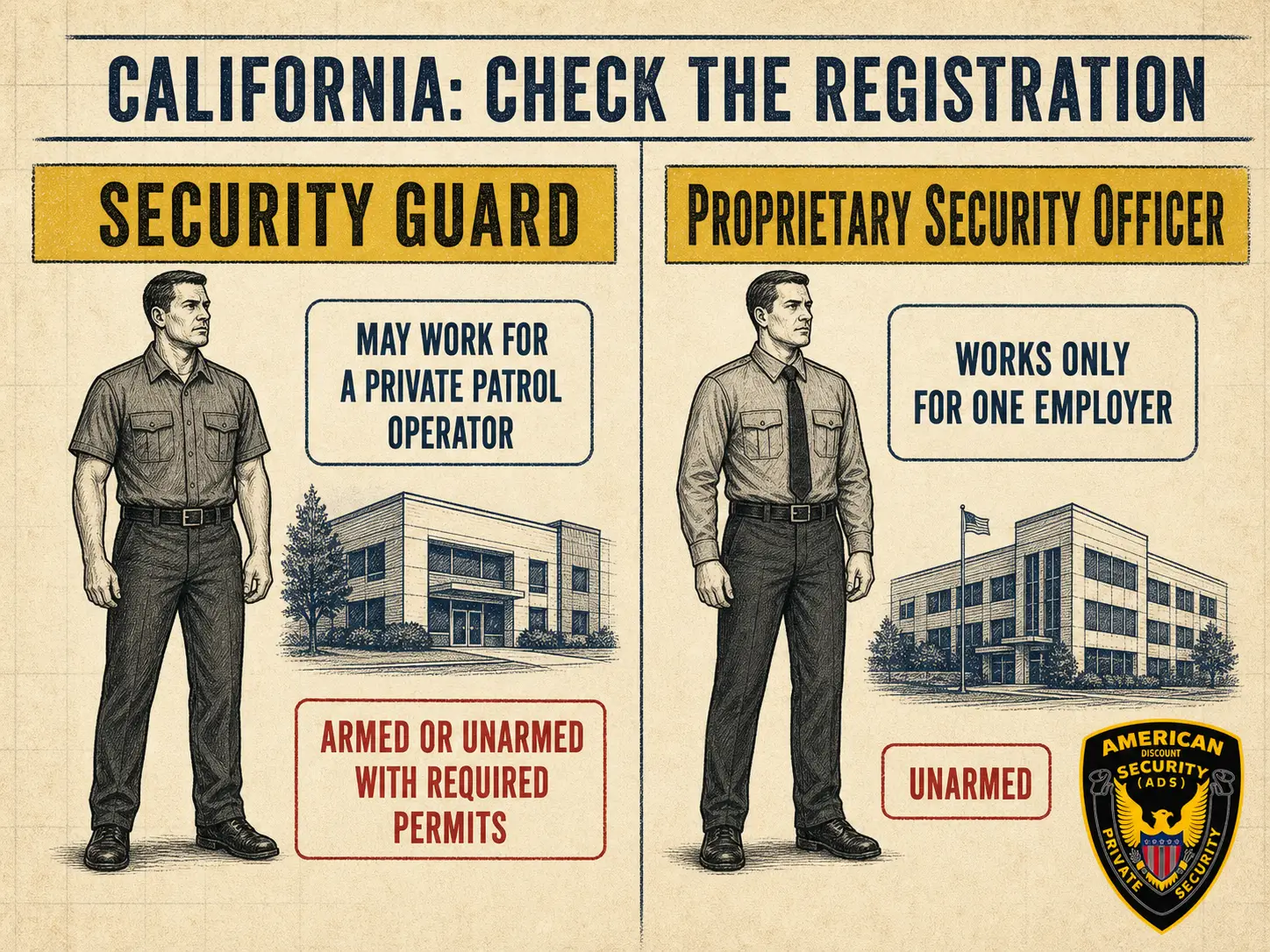
California adds a specific wrinkle to the security officer vs. security guard question. The state has separate registration categories for a security guard and a Proprietary Private Security Officer, or PSO.
According to the California Bureau of Security and Investigative Services, a PSO is generally an unarmed person who works exclusively for one employer, provides security only for that employer, wears a distinctive uniform, and is likely to interact with the public. This is an in-house security position. The employer cannot contract that officer’s services to another business.
A California security guard, by comparison, may work for a licensed private patrol operator that provides guard services to clients. The state’s security guard registration requirements cover background checks, training, and the registration a guard must carry while on duty.
This legal distinction is narrower than the everyday use of “security officer.” A company can place “Security Officer” on a uniform or job posting without necessarily referring to the state’s PSO category. California businesses should verify the worker’s actual registration and employment arrangement instead of relying on the title.
Armed status is a separate question
Neither title tells you whether a person carries a firearm. You can have an unarmed security guard, an unarmed security officer, or an armed position that uses either title.
In California, carrying a firearm on duty requires more than a guard registration. BSIS maintains a separate firearms permit process, including training and qualification requirements. The assignment also needs to call for armed coverage.
Businesses comparing armed security and unarmed security should base that choice on the site’s risks, working conditions, public contact, and response plan. Changing the job title doesn’t change the risk or the permit requirements.
What to ask before hiring security staff
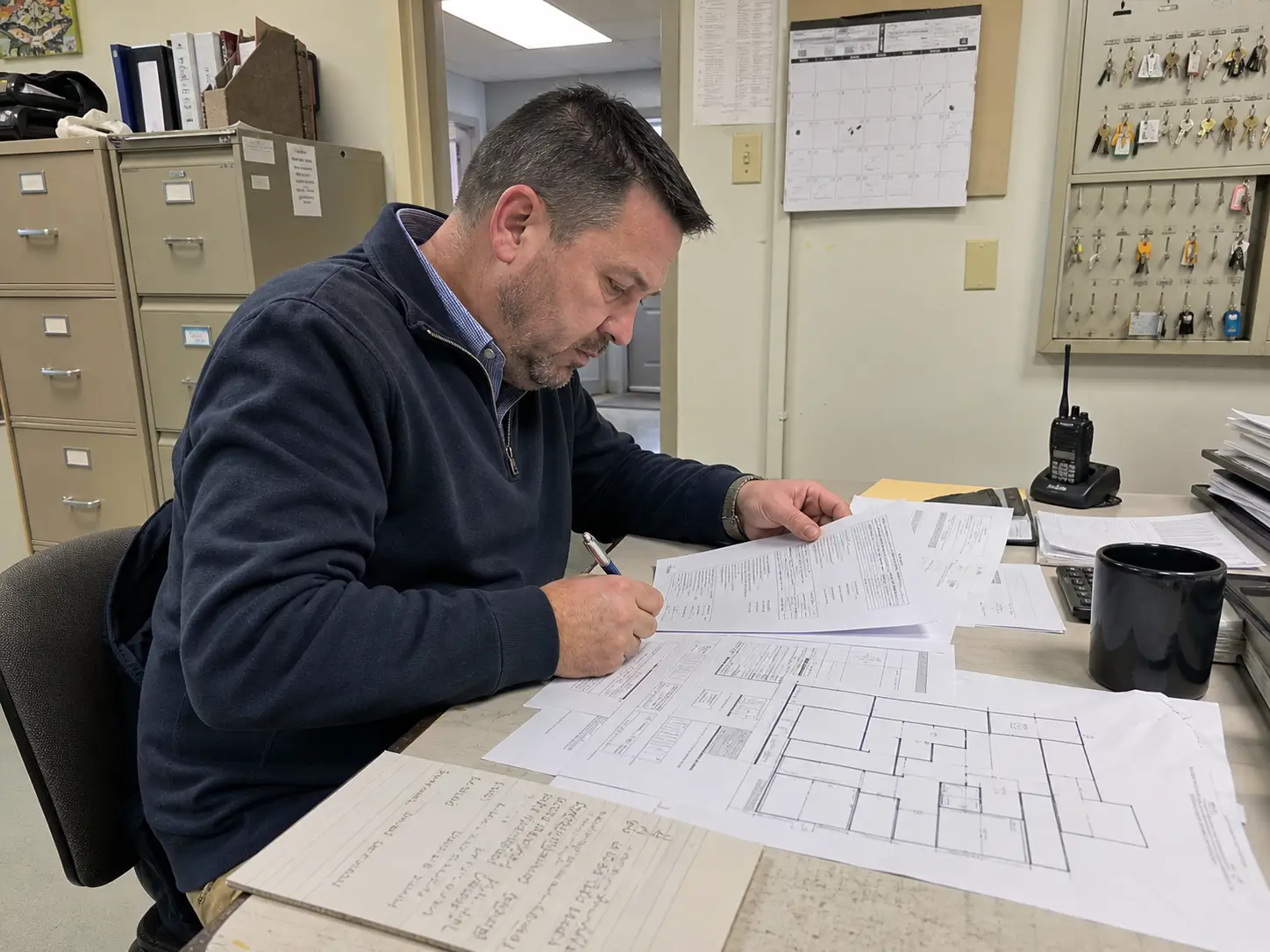
If you’re choosing a provider, “Do you send guards or officers?” won’t tell you much. Ask questions that reveal how the service will actually work.
- Who employs and supervises the staff assigned to the property?
- What licenses, registrations, permits, and background checks apply?
- What training does the assignment require beyond the legal minimum?
- Will staff work a fixed post, perform patrols, monitor cameras, or handle access control?
- Who responds when an incident exceeds the on-site person’s role?
- How are daily activity reports and incident reports delivered?
- What happens if the assigned person is absent?
- Who creates and updates the post orders?
The answers should match the site’s real problems. A warehouse with truck traffic, a hotel lobby, and a construction project after dark don’t need interchangeable plans just because each one hires “security officers.”
Some properties need a visible person at one entrance. Others need scheduled mobile patrol security, several posts, or a supervisor who can coordinate a larger team. A provider should be able to explain the staffing decision in plain terms.
Which role does your business need?
Start with the work that must be done. For a lower-risk fixed post, an unarmed guard or officer may handle visitor access, observe activity, and document problems. A large commercial property may need multiple staff members, patrol coverage, a shift lead, and clear escalation procedures. A site with credible threats or high-value assets may require a more experienced team and a careful review of whether armed coverage is appropriate.
The provider’s screening, training, supervision, and post orders matter far more than whether the proposal says “guard” or “officer.” When we build a commercial security plan, we match the assignment to the property instead of using a title as a shortcut.
Frequently asked questions
Is a security officer higher ranking than a security guard?
Sometimes, but not automatically. An employer may use “security officer” for a lead or supervisory position. Other employers use the two titles interchangeably. Check the job description, reporting structure, and assigned duties.
Are a security guard and a security officer the same thing?
In many workplaces, yes. Federal occupational sources group the titles together. State licensing categories and individual employers can create more specific distinctions.
Can a security officer carry a gun?
Only if the person has the permits required by the state and is working an armed assignment. The word “officer” does not provide firearms authority.
Does a security officer have more legal authority?
Not because of the title. A private security worker’s authority depends on applicable law, licensing, employer policy, and the circumstances. Security officers are not automatically police officers.
What is a Proprietary Private Security Officer in California?
A California PSO is generally an unarmed, uniformed security employee who works exclusively for one employer and interacts with the public. It is a specific BSIS registration category, not a general label for every person called a security officer.
Final thoughts on security officer vs. security guard
For most searches, security officer vs. security guard is a comparison between two titles for the same broad occupation. Some employers use “officer” for a senior or specialized job, and California has a distinct in-house PSO category, but the label by itself proves very little.
Before hiring, look at the licenses, duties, supervision, training, post orders, and response plan. Those details determine what protection you’re getting.