
Cash handling policy for businesses: procedures, risks and safety tips
A cash handling policy usually feels like one of those boring documents nobody wants to write. Then a drawer comes up short. Or a deposit is missing. Or someone realizes the same employee has been closing alone every night with too much cash sitting in the register.
That’s when the boring document suddenly matters.
Cash is easy to lose, easy to skim, and easy to mishandle when the process is loose. Most problems do not start with some dramatic movie style theft. They start with small habits: shared register logins, skipped drawer counts, safe codes everyone knows, deposits leaving at the same time every day.
A good cash handling policy fixes that. It gives employees clear rules for taking, counting, storing, moving, and depositing cash. It also helps protect your team, because cash handling is not just an accounting issue. It can become a safety issue fast.
If you are already working on broader internal security, this pairs well with a workplace theft prevention plan.
What is a cash handling policy?
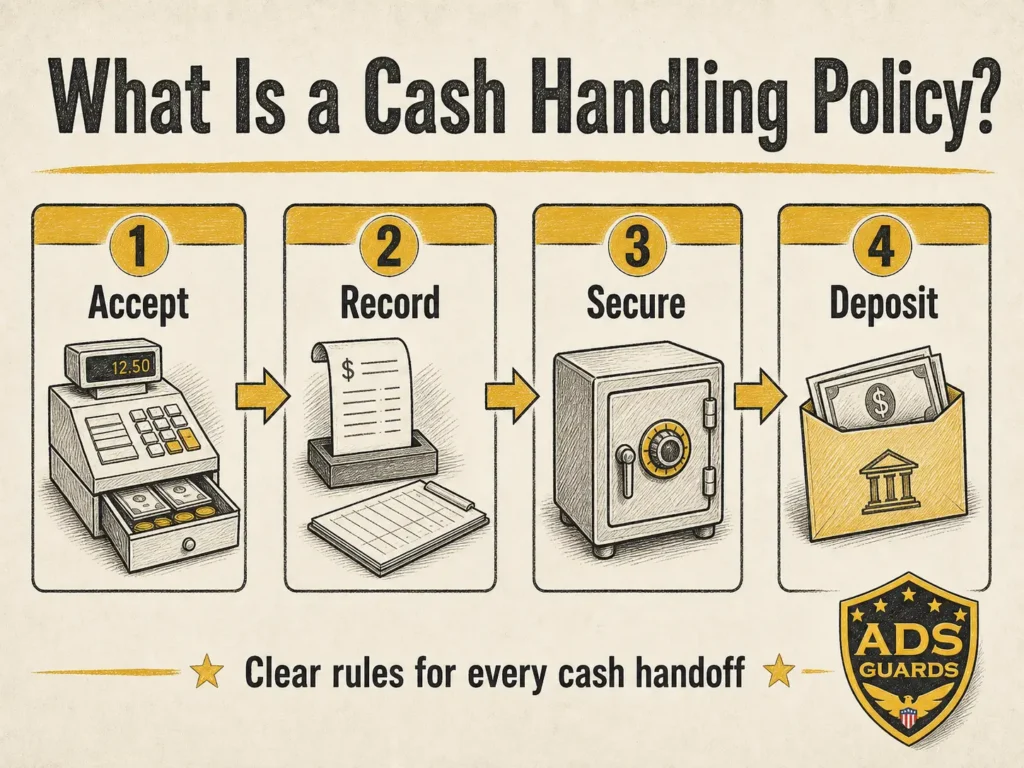
A cash handling policy is a written set of rules for how your business accepts, records, counts, stores, transports, and deposits cash.
It should make daily cash work simple, not confusing. Employees should not have to guess who counts the drawer, when to drop large bills, or what to do if the register is short.
A solid cash handling policy usually answers questions like:
- Who can access each cash drawer?
- How much cash should stay in the register?
- When should large bills be moved to the safe?
- Who counts cash at shift change?
- Who prepares deposits?
- Who verifies deposits?
- What happens when there is a shortage?
- What should employees do during a robbery?
The point is control. Not paranoia. Not micromanaging every move. Just clear rules so cash does not float around the business with no paper trail.
Why businesses need cash handling policy and procedures
Any business that accepts cash has cash handling risks.
Retail stores, restaurants, gas stations, event venues, medical offices, parking operations, property offices, warehouses with customer payments, and service businesses all deal with some version of the same problem: cash moves quickly, and if the process is weak, mistakes and theft are harder to catch.
Cash handling policy and procedures help reduce:
- Short drawers
- Employee theft
- Fake refunds
- Unapproved voids
- Skimming
- Deposit mistakes
- Disputes over change
- Unsafe closing routines
- Robbery exposure
The biggest benefit is consistency. When everyone follows the same steps, managers can compare drawer counts, POS reports, deposit slips, camera footage, schedules, and incident reports without piecing the whole thing together from memory.
If your business has frequent customer traffic, late hours, or higher theft exposure, our commercial security services can help support the physical side of the process. That might include visible security, access control support, patrols, reporting, or site-specific procedures around closing and cash movement.
Common cash handling risks
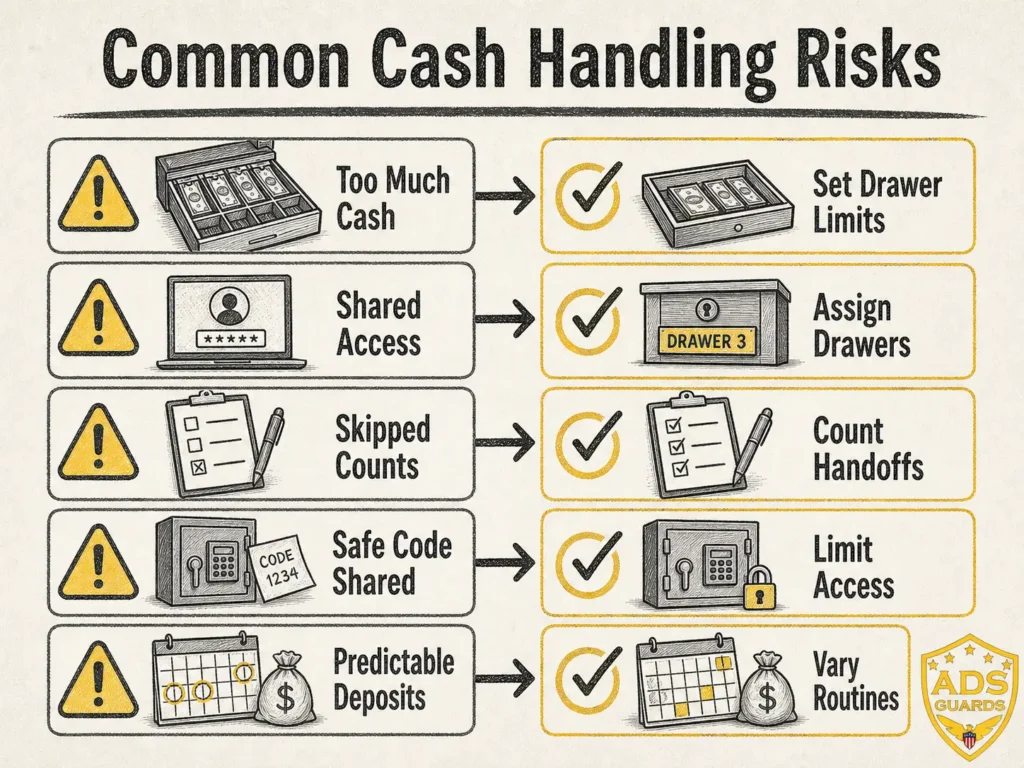
Most cash handling problems are not complicated. They come from loose habits that keep repeating.
| Cash handling risk | What it looks like | Better control |
|---|---|---|
| Too much cash in the drawer | Large bills sit in the register for hours | Set drawer limits and move excess cash to the safe |
| Shared register access | Multiple employees use the same drawer or login | Assign drawers and logins whenever possible |
| Weak shift changes | Employees pass drawers without counting | Count and sign off at every handoff |
| Too many people know the safe code | Former staff or unrelated employees still have access | Limit access and change codes when roles change |
| Predictable deposits | Same person, same route, same time every day | Vary deposit routines and use two-person controls when needed |
| Poor shortage tracking | Managers mention shortages but do not document them | Use written shortage logs and incident reports |
| Closing alone | One employee counts cash after dark with no support | Add closing steps, lighting, and security coverage where needed |
Cash handling safety also overlaps with workplace violence prevention. OSHA lists money exchange with the public, working alone, late night work, isolated areas, alcohol service, and high crime locations as risk factors for workplace violence. That is why your cash handling safety tips should cover more than register math. They should also cover what keeps employees safe. See OSHA’s guidance on workplace violence risk factors.
Cash handling procedures to include in your policy
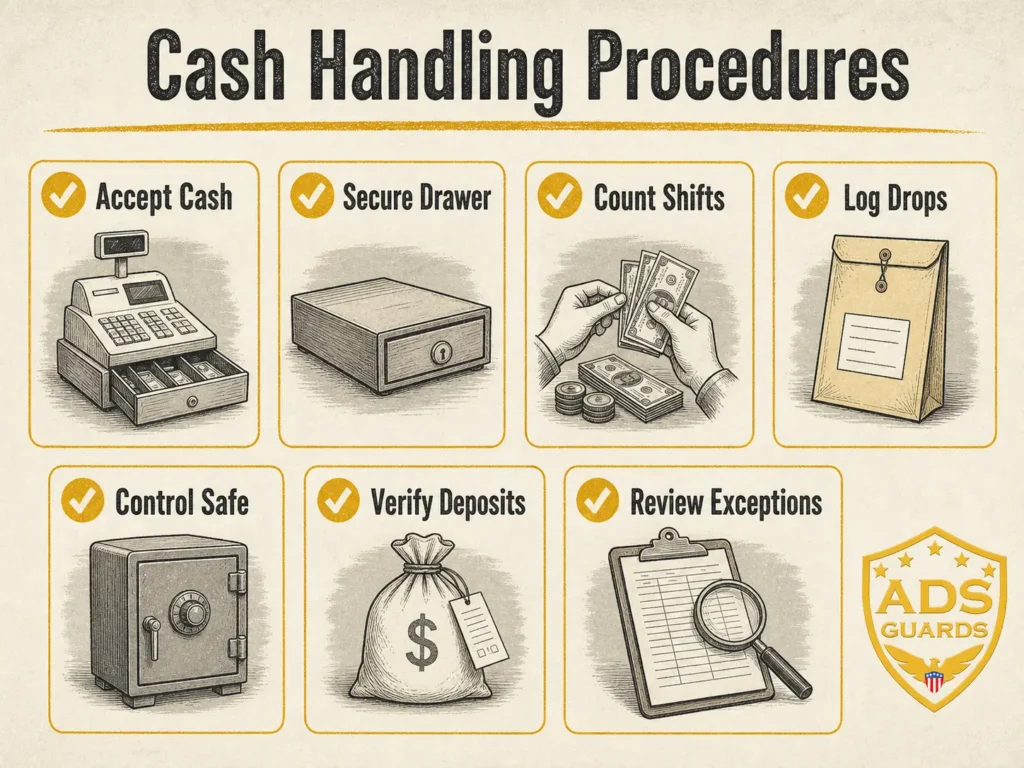
The best cash handling procedures are easy to follow during a normal shift. If the process is too complicated, people skip steps.
Here are the pieces most businesses should include.
1. Cash acceptance rules
Start with how employees should accept cash in the first place.
Your policy should cover:
- Who is allowed to accept cash
- How cash payments are entered into the POS system
- Whether employees should check large bills
- What to do if a bill looks suspicious
- How to handle customer disputes over change
- Whether employees can leave the register during a cash transaction
- When a supervisor needs to step in
For retail cash handling procedures, one rule matters a lot: finish one transaction before starting another. Mistakes happen when the cashier is rushed, interrupted, or trying to handle two customers at once.
2. Cash drawer security
Cash drawer security is one of the easiest places for things to get messy.
The drawer opens all day. Employees get busy. Managers trust the team. Someone needs change. Someone else needs to use the register for “just one transaction.” By the end of the shift, nobody knows who touched what.
Your cash handling policy should make this clear:
- Assign one drawer to one employee when possible
- Do not share register logins
- Keep the cash drawer closed unless a transaction is happening
- Move large bills out of the drawer once they hit the limit
- Keep personal money and personal items away from the drawer
- Review refunds, voids, discounts, and no-sale openings
Cash register security tips do not need to be fancy. Keep access limited. Keep the drawer closed. Keep cash levels low. Review anything that looks unusual.
3. Opening and closing drawer counts
Every drawer should start with a known amount and end with a verified count.
Your employee cash handling procedures should include:
- Opening cash amount
- Who verifies the opening drawer
- How shift changes are counted
- Who counts the drawer at closing
- Where the count happens
- How overages and shortages are recorded
- When a manager must review the drawer
Do not let drawer shortages become casual. A small mistake can happen to anyone. Repeated shortages need attention.
4. Safe access and back office controls
The safe should not be treated like a shared cabinet.
Your policy should say:
- Who has safe access
- Who can change the code
- When safe codes must be changed
- How cash drops are logged
- Where cash is counted
- Whether cameras cover the counting area
- How long cash can stay on site
- Who can remove cash from the safe
Too many businesses give safe access to too many people because it makes the day easier. It also makes missing cash harder to investigate.
5. Cash drops
A cash drop moves excess cash from the drawer to the safe during a shift.
This is one of the simplest ways to reduce loss. It also helps with robbery prevention because less cash is sitting in the register.
Your cash handling policy should set:
- Maximum cash allowed in each drawer
- When large bills must be dropped
- Who can perform a cash drop
- How drops are logged
- Whether another employee must witness the drop
- Where drop envelopes are stored
Do not wait until the end of the day to remove excess cash. If the drawer is heavy, the risk is already there.
6. Deposit procedures
Deposits are where cash leaves the building, so the process needs tighter control.
Your deposit procedure should explain:
- Who prepares the deposit
- Who verifies the deposit
- What forms or logs are required
- Where deposits are stored before transport
- Who can transport deposits
- Whether two employees are required
- Whether deposit times and routes should vary
- What employees should do if they feel unsafe
The routine matters. If someone can watch your business for a few days and know exactly when the deposit leaves, that is a problem.
For locations with late-night deposits, larger cash volume, or isolated parking areas, our mobile patrol security can help add visibility around vulnerable times. Patrols can support lockups, exterior checks, parking lot activity, and suspicious activity reporting without requiring a fixed guard post all day.
7. Refunds, voids, discounts, and no-sale activity
A lot of cash theft hides inside transactions that look normal at first glance.
Managers should review:
- Refunds without receipts
- Cash refunds after card payments
- Repeated voids
- Manual discounts
- No-sale drawer openings
- Price overrides
- Multiple shortages tied to the same employee
- Refunds processed near closing
One odd transaction does not prove theft. A pattern tells you where to look.
This is also where your cash handling policy should connect with your larger workplace theft prevention process. Cash handling is one piece of the puzzle. Inventory, access, cameras, scheduling, and supervision matter too.
8. Robbery prevention procedures
Robbery prevention tips for businesses should be simple enough for employees to remember under stress.
Your policy should tell employees:
- Keep cash levels low
- Do not argue with a robber
- Do not chase anyone
- Follow instructions as safely as possible
- Notice details only if it is safe
- Lock the doors after the person leaves, if safe
- Call 911
- Preserve the area
- Write down what happened as soon as possible
Business robbery prevention also depends on the physical setup. Good lighting, working cameras, clear sightlines, visible signage, secure doors, and safe closing routines all matter.
If your business is in a retail plaza, shopping center, or mall, our shopping center security guards can help support tenants, deter theft, watch common areas, respond to incidents, and keep a visible presence where cash-heavy businesses may be more exposed.
The $10,000 cash rule businesses often confuse
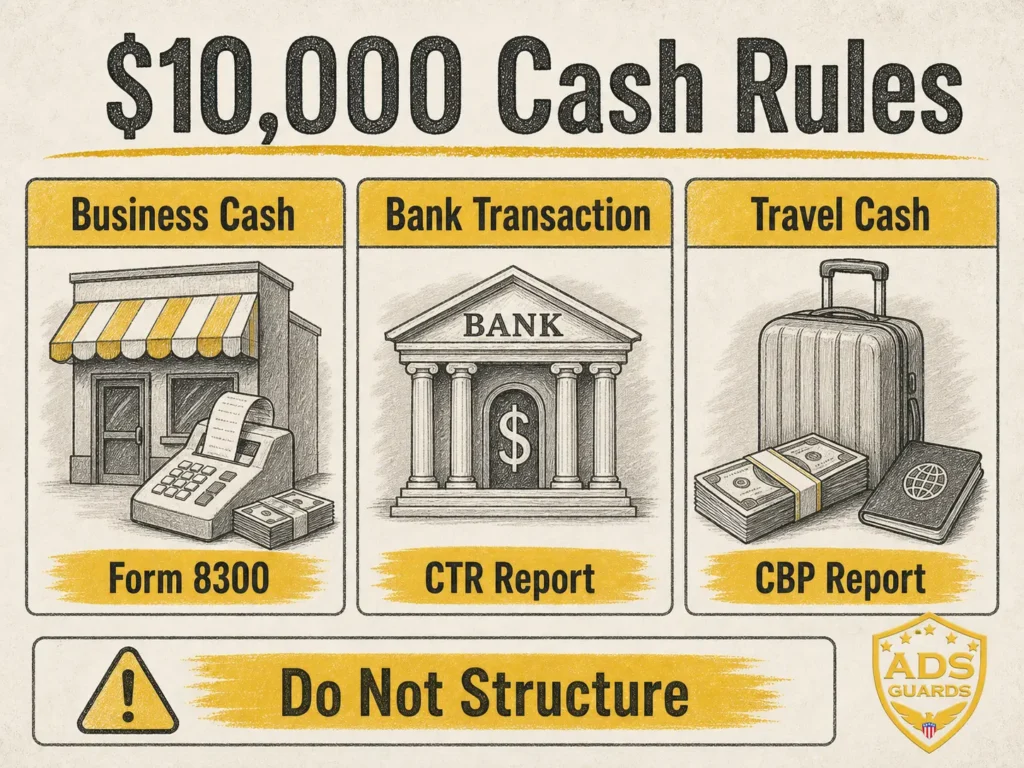
There are a few different $10,000 cash rules, and people mix them up all the time.
For businesses, the big one is IRS Form 8300. If a business receives more than $10,000 in cash in one transaction or related transactions, the IRS generally requires the business to file Form 8300. The IRS says the form is due within 15 days after the cash transaction. You can read the IRS rules for reporting cash payments over $10,000.
The bank rule is different. Federal regulations require financial institutions to report currency transactions over $10,000, including deposits, withdrawals, exchanges, payments, or transfers. The rule appears in 31 CFR 1010.311.
Carrying cash is another separate issue. It is not automatically illegal to carry $10,000 in cash. USAGov says there is no limit on how much money you can travel with, but if you enter or leave the United States with more than $10,000, you must report it to Customs and Border Protection. See USAGov’s page on traveling with money.
Also, do not try to break cash transactions into smaller amounts to avoid reporting. FinCEN warns that this is called structuring, and it can be illegal. FinCEN explains this in its guide on currency transaction reporting and structuring.
A cash handling policy should never be about avoiding reporting rules. It should help your business handle cash safely, document it correctly, and know when extra reporting steps apply.
Example cash handling policy for businesses
You can use this as a starting point and adjust it for your business, industry, location, and legal requirements.
Cash handling policy example
All cash received by the business must be recorded through the approved register, POS system, receipt book, or payment log. Employees may not keep business cash in personal bags, pockets, desks, vehicles, or unsecured areas.
Each cash drawer should be assigned to one employee whenever possible. Employees may not share register logins. Cash drawers must stay closed unless a transaction is being processed.
Managers will set a maximum cash amount for each drawer. When a drawer exceeds that amount, the employee must complete a cash drop. Cash drops must be logged and placed in the safe right away.
Cash must be counted at the start and end of each shift. Any shortage or overage must be reported to a manager and recorded before the employee leaves.
Refunds, voids, discounts, and no-sale drawer openings may be reviewed by management. Employees may not approve their own cash refunds unless the policy allows it and a manager has reviewed the transaction.
Deposits must be prepared in a secure area. When possible, two authorized employees should verify the deposit. Deposit transport should not happen at the same time, with the same person, using the same route every day.
Employees should not transport deposits if they feel unsafe.
During a robbery, employee and customer safety comes first. Employees should not resist, argue, or chase anyone. After the incident, employees should call 911, preserve the area, notify management, and complete an incident report.
This policy applies to all employees who accept, count, store, transport, or supervise cash.
Cash handling best practices that actually work
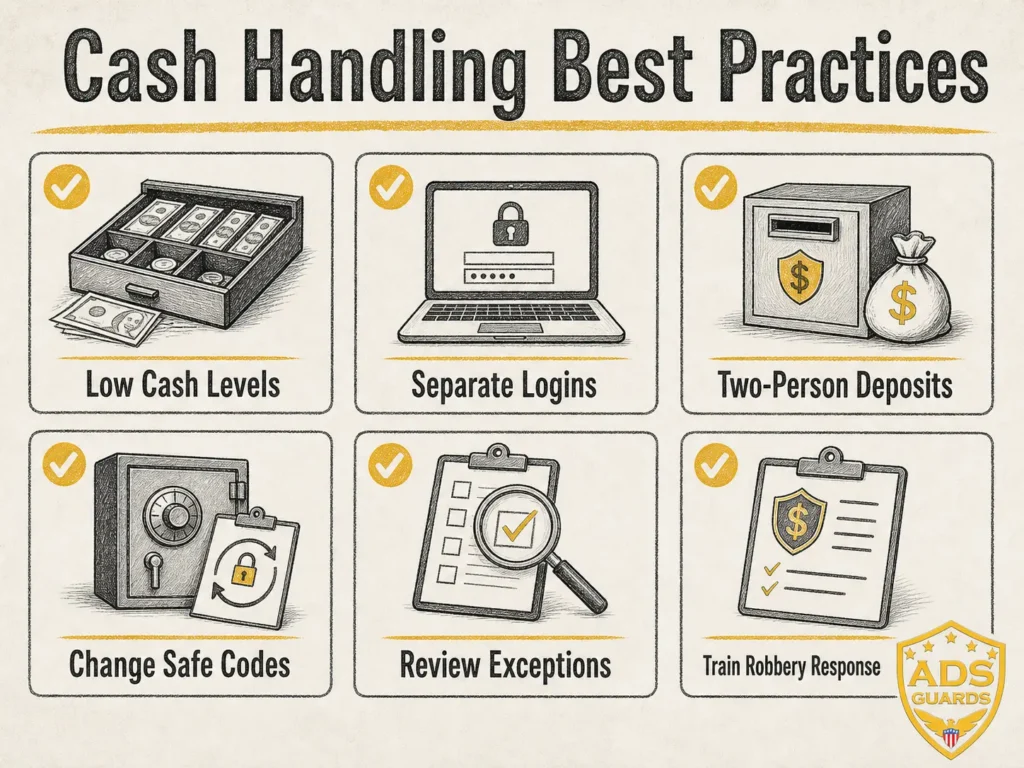
Most cash handling best practices are simple. They just need to be followed every time.
Keep cash levels low. Limit access. Count at handoffs. Separate duties when possible. Review exceptions. Document shortages. Train employees before something goes wrong.
A few best practices are worth spelling out:
- Use separate register logins for each employee
- Count drawers at opening, shift change, and closing
- Set a cash limit for each drawer
- Move large bills to the safe during the shift
- Limit who knows the safe code
- Change safe codes after staff changes
- Use two-person verification for deposits when possible
- Review refunds, voids, discounts, and no-sale activity
- Keep deposit times and routes less predictable
- Train employees on robbery response
If you already have guards on site, cash-related instructions should be built into your security guard post orders. That can include areas to watch during closing, who to contact after a suspicious incident, when patrols should check parking areas, and how guards should document concerns.
Post orders are where vague security expectations become actual instructions. Cash handling should not be left out of that.
FAQ
What are cash handling policies?
Cash handling policies are written rules for accepting, counting, storing, recording, transporting, and depositing cash. They help employees follow the same process every time and reduce mistakes, theft, and unsafe cash routines.
Is it illegal to carry $10,000 in cash?
No. It is not automatically illegal to carry $10,000 in cash. USAGov says there is no limit on how much money you can travel with. But if you enter or leave the United States with more than $10,000, you must report it to Customs and Border Protection. You can read more on USAGov’s page about traveling with money.
What are cash handling procedures?
Cash handling procedures are the steps employees follow when they accept, count, store, move, or deposit cash. They usually cover register use, drawer counts, cash drops, safe access, deposits, refunds, voids, shortages, and robbery response.
What is the $10,000 bank rule?
The $10,000 bank rule is the federal requirement for financial institutions to report currency transactions over $10,000. This includes deposits, withdrawals, exchanges, payments, and transfers. The rule is listed in 31 CFR 1010.311.
What are cash handling?
Cash handling means any task involving physical cash. That can include taking payments, making change, counting a register, preparing a deposit, storing cash in a safe, moving cash to the bank, or reconciling drawer totals.
What is an example of cash handling?
An example of cash handling is a cashier taking a $50 bill from a customer, entering the sale into the register, giving the correct change, closing the cash drawer, and later balancing that drawer at the end of the shift.
What are common cash handling mistakes?
Common cash handling mistakes include sharing register logins, leaving drawers open, keeping too much cash in the register, skipping shift counts, failing to document shortages, letting one person control the entire cash process, and using predictable deposit routines.
What is another name for cash handling?
Another name for cash handling is cash management. Some businesses also call it cash control, cash operations, cash management procedures, or cash handling policy and procedures.
Final thoughts
A cash handling policy does not have to be complicated. It just has to be clear enough for employees to follow on a busy day.
The basics matter most: assign drawers, count cash, limit access, drop large bills, control deposits, review exceptions, and train employees on what to do if something feels unsafe.
If your business is dealing with repeated cash shortages, late-night deposits, retail theft, aggressive customers, or employees closing alone, cash handling should be part of a bigger security plan.
At American Discount Security (A.D.S.), we help businesses tighten up daily security with visible guards, patrol planning, site procedures, reporting, and post orders that actually match the property. If cash handling risk is becoming a concern, our guide on security guard benefits for businesses is a good next read, or you can start with our commercial security services.