

Lone worker safety: 12 tips every business should follow

An employee working alone may be perfectly comfortable right up until something goes wrong.
A fall, medical emergency, aggressive customer, equipment failure, or suspicious person becomes harder to handle when nobody else is nearby. Even a minor incident can become serious if the worker cannot call for help or management does not realize there is a problem.
Lone worker safety is about closing that gap. Businesses need to know who works alone, what could happen during those shifts, and how help will reach the employee when they need it.
What is lone worker safety?
Lone worker safety is the set of policies, procedures, equipment, training, and security measures used to protect employees who work without direct supervision or nearby coworkers.
Someone does not have to be completely isolated to count as a lone worker. An employee may be considered alone when they cannot be seen or heard by another person or cannot expect quick help during an emergency.
The NIOSH overview of lone work notes that working alone happens in many industries and can introduce additional safety and health risks.
Common examples include:
- A security guard patrolling a property at night
- A cashier closing a store alone
- A cleaner working after business hours
- A maintenance technician in an isolated area
- A warehouse employee working in a separate section
- A delivery driver or field service technician
- A property manager showing an empty building
- A healthcare worker visiting a patient’s home
- An employee arriving early or staying late
- A construction worker checking an inactive site
The job itself may not seem dangerous. The bigger issue is what happens when an employee working alone cannot get immediate assistance.
What are the hazards of lone workers?
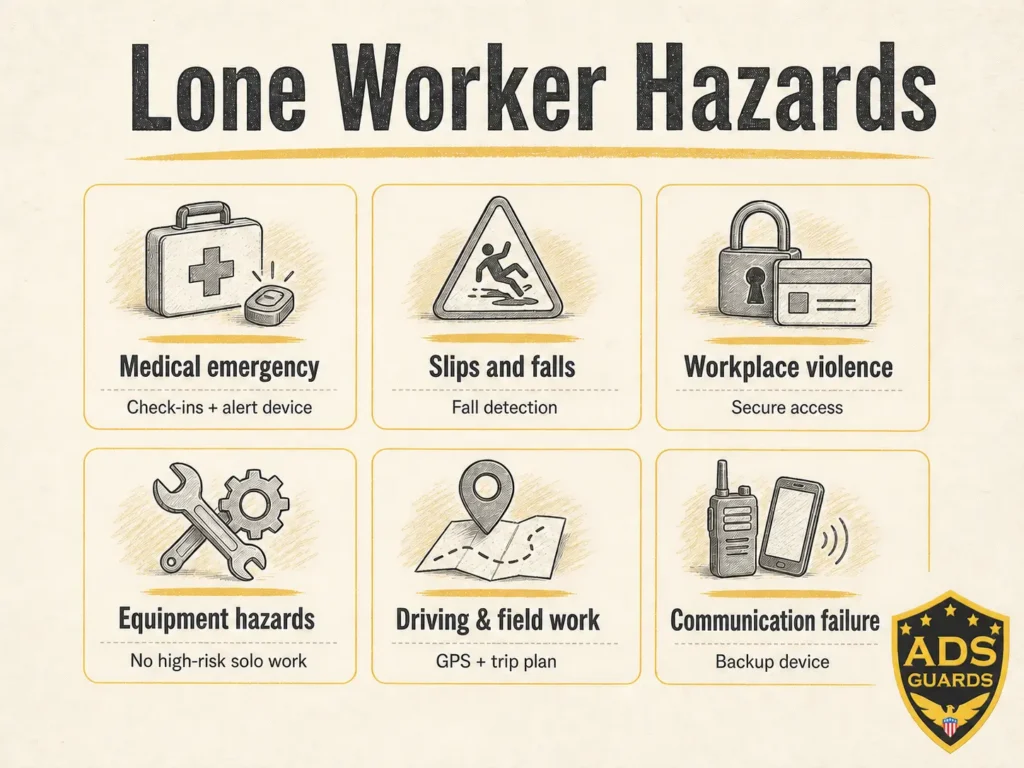
Lone worker hazards depend on the job, location, time of day, and people the employee may encounter. There is no single checklist that fits every workplace.
Still, a few risks show up again and again.
| Lone worker hazard | What could happen | Possible control |
|---|---|---|
| Medical emergency | The employee becomes sick, faints, or has an allergic reaction | Scheduled check-ins and an emergency alert device |
| Slips and falls | Nobody sees the fall or notices the employee is injured | Fall prevention, location tracking, and missed check-in alerts |
| Workplace violence | An employee faces an aggressive customer, intruder, or robbery attempt | Secure access, cameras, alarms, training, and security coverage |
| Machinery or electrical hazards | The employee becomes trapped, shocked, or injured | Prohibit high-risk tasks while alone and use lockout procedures |
| Cash handling | A closing employee becomes a robbery target | Lower cash levels, safer closing procedures, and security presence |
| Driving and field work | A vehicle breaks down or the employee becomes stranded | Trip plans, GPS, check-ins, and roadside procedures |
| Outdoor exposure | Heat, cold, smoke, or severe weather affects the worker | Weather monitoring, water, rest periods, and stop-work rules |
| Communication failure | The worker cannot call for help from a dead zone | Backup devices and tested communication methods |
| Fatigue and stress | A tired worker misses hazards or makes poor decisions | Reasonable scheduling, breaks, and limits on extended shifts |
Working alone can also increase exposure to workplace violence. OSHA identifies working alone, exchanging money with the public, providing services, driving passengers or making deliveries, and working late at night as factors that may increase the risk of workplace violence.
A business with these concerns should connect its lone worker procedures to a broader workplace violence prevention plan.
Start with a lone worker risk assessment
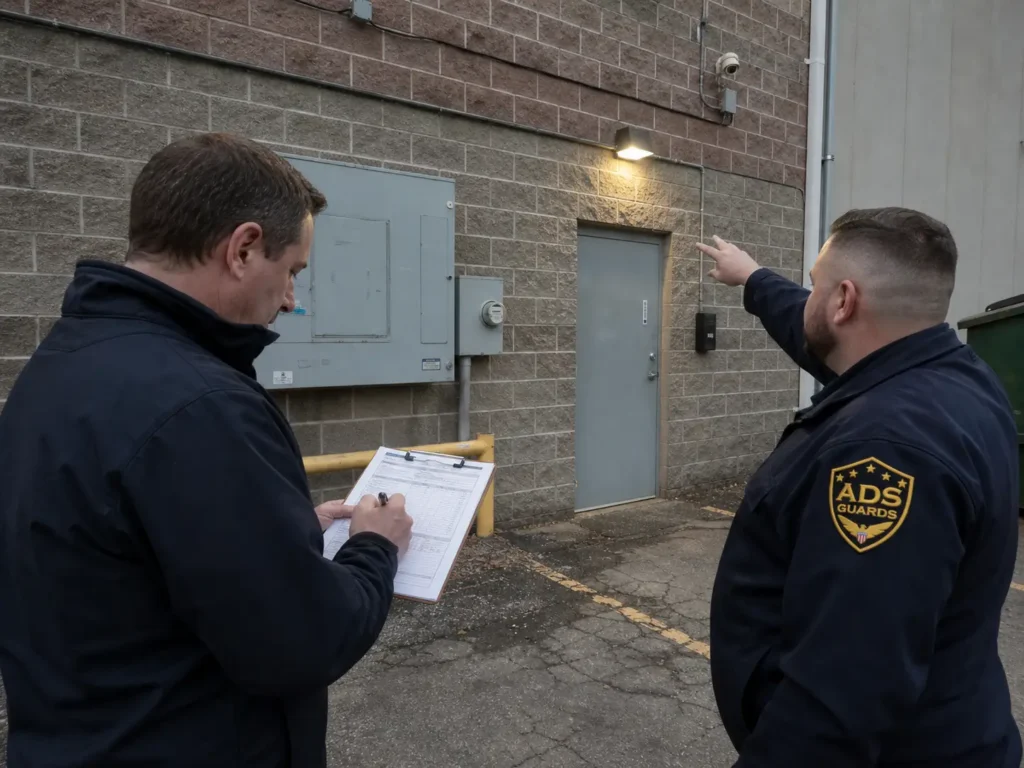
You cannot write a useful lone worker policy until you know where the risk is.
A lone worker risk assessment looks at each job, task, shift, and location where an employee may be alone. It should consider both the chance of an incident and how serious the outcome could become without immediate help.
OSHA’s hazard identification and assessment guidance recommends reviewing all work areas and tasks, talking with employees, inspecting workplaces, and investigating previous incidents.
A working alone risk assessment should answer these questions:
- Which employees work alone?
Include employees who open, close, travel, work remotely, enter restricted areas, or spend part of a shift outside normal contact with others.
- What tasks do they perform?
Do not assess the job title alone. A maintenance employee changing a lightbulb faces a different risk from the same employee repairing energized equipment.
- What could go wrong?
Look at injuries, illness, violence, severe weather, equipment failure, vehicle trouble, unauthorized access, poor lighting, and communication dead zones.
- How quickly could someone help?
A five-minute delay may be manageable in one situation and life-threatening in another.
- Should this task ever be performed alone?
Some work needs a second employee, attendant, spotter, or trained emergency responder. Do not try to make an unsafe lone assignment acceptable with an app and a check-in timer.
- What controls would reduce the risk?
Possible controls include changing the schedule, adding another employee, improving lighting, restricting public access, providing alarms, arranging patrols, or removing the hazardous task.
Your assessment should also include a walkthrough of the property. Our physical security assessment checklist can help identify weak entrances, dark areas, damaged locks, blocked cameras, and other problems that may affect lone employee safety.
Create a written lone worker policy
A lone worker policy gives employees and managers one clear process to follow. It should be part of your safety program rather than an informal agreement between a supervisor and whoever happens to work late.
Your working alone policy should cover:
- Which roles and situations qualify as lone work
- Tasks employees may not perform alone
- Required check-in times
- Approved communication devices
- How employees report a location change
- What happens after a missed check-in
- When an employee should leave or refuse an unsafe situation
- Emergency contacts and escalation steps
- Incident reporting requirements
- Manager and supervisor responsibilities
- Training and refresher requirements
- How often the policy will be reviewed
Keep it usable. A policy nobody remembers during an emergency is not doing much good.
Employees should know exactly who is monitoring them, how often they must check in, and what will happen if they miss a call.
12 lone worker safety tips businesses can use
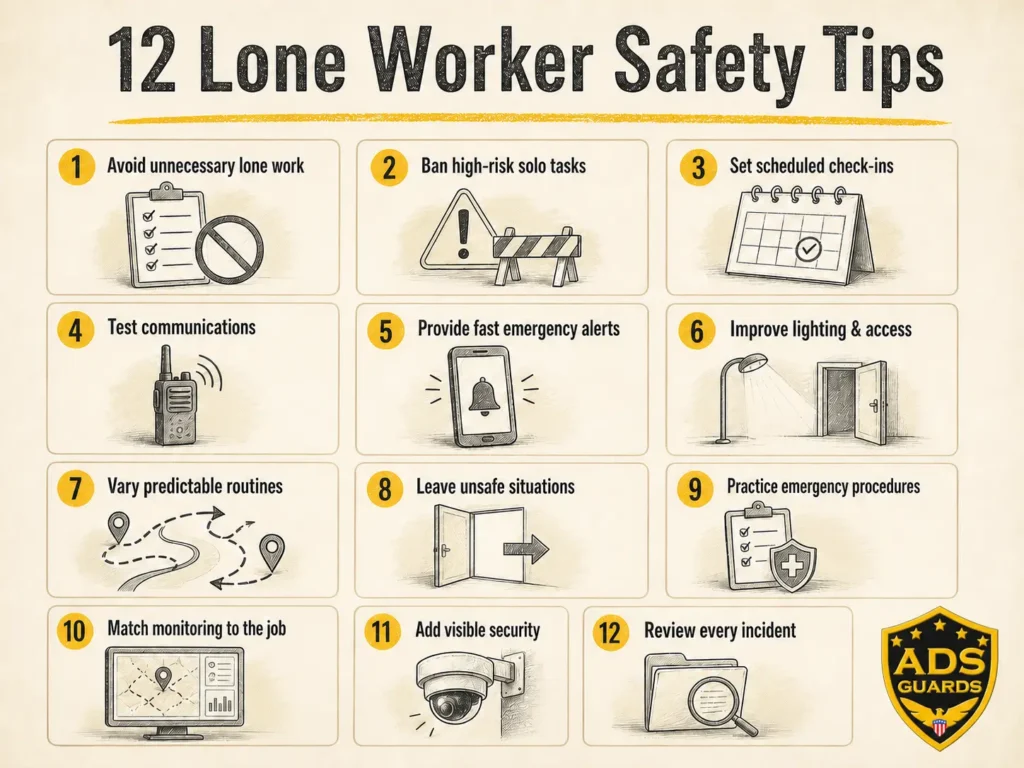
1. Avoid unnecessary lone work
The safest option is often to stop assigning certain tasks to one person.
Schedule higher-risk work when more employees are present. Use two-person teams for tasks involving dangerous equipment, isolated areas, hostile customers, large cash deposits, or locations with a history of incidents.
2. Set clear limits on prohibited tasks
Your lone worker procedures should identify work that cannot be performed alone.
This may include entering confined spaces, working at significant heights, handling certain hazardous materials, repairing energized equipment, or confronting suspicious people.
Employees should not feel pressured to “just get it done” because the shift is short staffed.
3. Use a reliable check-in process
Check-ins may happen by phone, radio, text, app, or an automated monitoring platform.
The schedule should match the risk. A low-risk office employee may check in at the start and end of a shift. A guard patrolling an isolated industrial property may need much more frequent contact.
Your procedure should state:
- Who initiates each check-in
- How often it occurs
- What information the employee provides
- How long the monitor waits before following up
- Who responds when contact cannot be made
4. Test communication before the shift
A phone does not help when the battery is dead or the work area has no signal.
Test radios, phones, panic buttons, wearable devices, and monitoring apps in the actual locations where employees work. Provide a backup method when coverage is unreliable.
Workers should also know where emergency phones, exits, alarms, and first aid supplies are located.
5. Give employees a fast way to request help
In an emergency, an employee may not have time to unlock a phone, find a contact, and explain their location.
Depending on the risk, businesses may use:
- Panic buttons
- Wearable alarms
- Two-way radios
- Duress codes
- GPS-enabled devices
- Automatic fall detection
- Man-down alerts
- Vehicle emergency systems
The alert must reach someone who is prepared to act. An alarm sent to an unattended inbox is not an emergency system.
6. Improve lighting and access control
Dark parking areas, unlocked rear doors, hidden entrances, and overgrown landscaping can make an employee working alone more vulnerable.
Walk the property after dark, not only during normal business hours. Check exterior lights, doors, gates, cameras, intercoms, and sightlines.
Our guide to parking lot safety for businesses and employees covers several problems that are easy to miss during a daytime inspection.
7. Change predictable routines
A person watching the property should not be able to predict exactly when one employee leaves, carries a deposit, locks a gate, or walks to a remote building.
Vary routes and timing when practical. Avoid posting detailed employee schedules where customers or visitors can see them.
For cash-heavy businesses, lone worker safety should also connect with the company’s cash handling policy. Closing alone with visible cash creates a risk that accounting procedures cannot solve by themselves.
8. Train employees to leave unsafe situations
Workers sometimes stay because they do not want to look nervous, upset a customer, or call a manager over “nothing.”
Your policy should give them permission to stop work, move to a secure area, or leave when conditions become unsafe.
Examples include:
- A person refusing to leave after closing
- Signs of forced entry
- Threatening behavior
- An unknown vehicle following a field employee
- A broken exterior light near the employee entrance
- A failed alarm or communication device
- Severe weather affecting travel or outdoor work
Employees should report the concern, but they should not be expected to investigate it alone.
9. Prepare lone worker emergency procedures
Your lone worker emergency procedures should address more than calling 911.
Employees need to know:
- How to trigger an emergency alert
- What information to provide
- Where to shelter or exit
- When not to confront a person
- Who meets emergency responders
- Who contacts the employee’s emergency contact
- How managers preserve video and incident records
- What happens before the employee returns to work
Run practice scenarios. A short drill will uncover confusing instructions faster than another policy meeting.
10. Use monitoring that matches the job
Lone worker monitoring can include scheduled calls, GPS, patrol checkpoints, motion sensors, wearable devices, video monitoring, or dispatch support.
More technology is not automatically better. Choose a system employees can use consistently and supervisors can manage properly.
Explain what data is collected, why it is needed, who can view it, and how long it is kept. Monitoring should protect workers without turning every shift into unnecessary surveillance.
11. Add visible security where the risk supports it
Some locations need more than remote check-ins.
A trained guard or mobile patrol can check entrances, walk parking areas, respond to alarms, document suspicious activity, and make sure an employee is not left completely unsupported during vulnerable hours.
Our mobile patrol security services may suit properties that need periodic checks rather than a fixed guard for the full shift. Businesses with regular public traffic or ongoing site risks may need broader commercial security services.
12. Review every missed check-in and incident
A missed call may be a forgotten reminder. It may also show that the schedule, device, or response procedure is not working.
Review:
- Missed and late check-ins
- Alarm activations
- Communication failures
- Near misses
- Employee concerns
- Unauthorized access
- Aggressive customer incidents
- Injuries and medical events
- Delays in reaching the worker
Ask the employee what would have helped. The person doing the job often notices weaknesses that never appear in a manager’s written plan.
What is a lone worker safety system?
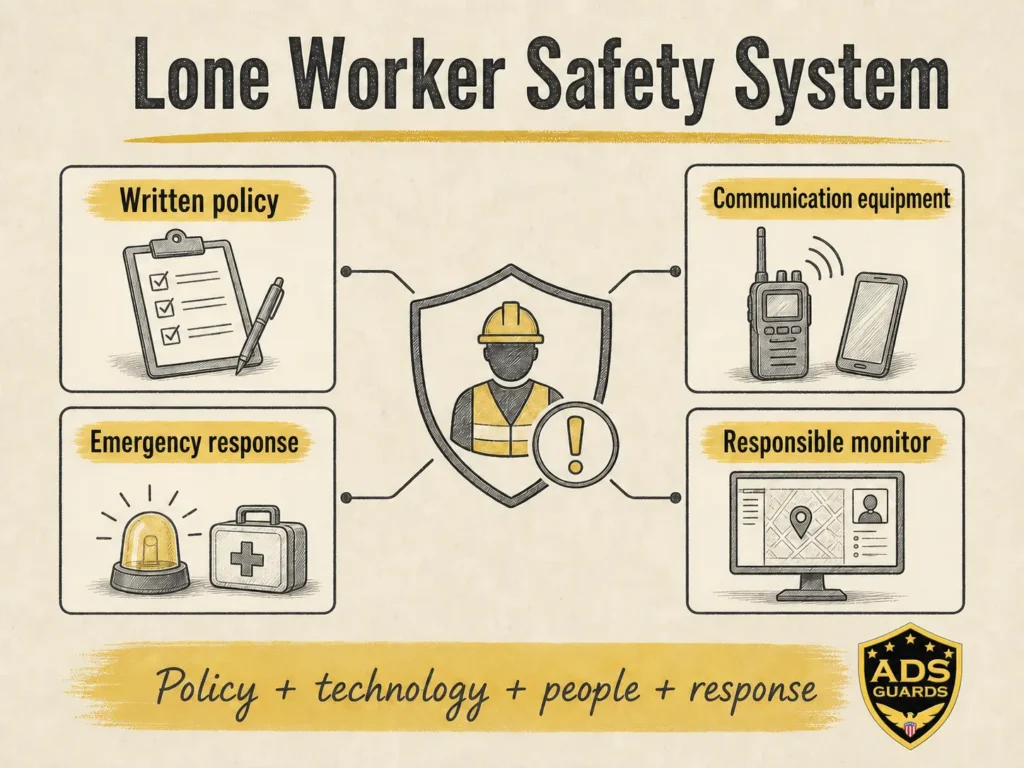
A lone worker safety system is the complete process used to protect and monitor employees who work alone.
It usually combines four parts:
- A written lone worker policy
- Communication or monitoring equipment
- Clear emergency response procedures
- A responsible person or team that receives and acts on alerts
The technology is only one piece. A phone app cannot decide which work is too dangerous to perform alone, train an employee to handle an aggressive visitor, or send help when nobody is assigned to watch the alerts.
A useful system connects the employee, supervisor, monitoring method, and emergency response plan.
Lone worker safety checklist
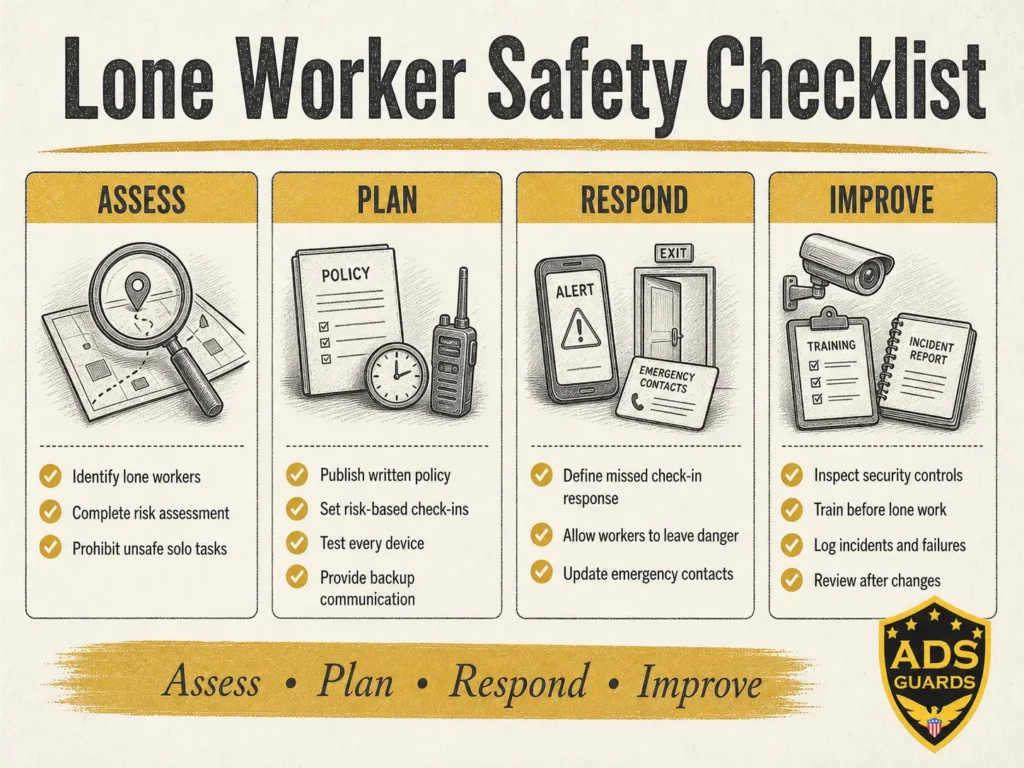
Use this checklist when reviewing working alone safety at your business:
- We know which employees work alone and when.
- We have completed a lone worker risk assessment.
- Employees know which tasks they cannot perform alone.
- Our working alone policy is written and accessible.
- Check-in times match the level of risk.
- Communication devices work in every assigned area.
- Employees have a backup way to request help.
- Missed check-ins trigger a clear response.
- Workers can leave unsafe situations without waiting for approval.
- Emergency contacts and site addresses are current.
- Lighting, locks, cameras, gates, and alarms are inspected.
- Employees receive training before working alone.
- We document incidents, near misses, and alarm failures.
- We review the policy after workplace or staffing changes.
Frequently asked questions
What is lone worker safety?
Lone worker safety is the use of policies, training, communication, monitoring, emergency procedures, and workplace controls to protect employees who work without nearby coworkers or direct supervision.
What are the hazards of lone workers?
Common lone worker hazards include delayed medical assistance, falls, workplace violence, robbery, machinery accidents, communication failure, vehicle trouble, severe weather, fatigue, and being unable to summon help quickly.
What is the lone worker safety system?
A lone worker safety system combines a working alone policy, risk assessment, check-in or monitoring technology, emergency alerts, and a response procedure. It should identify a problem and make sure the right person takes action.
What does OSHA say about working alone?
OSHA states that there is no general federal standard covering every situation in which an employee works alone. However, employers must comply with all applicable OSHA standards and the General Duty Clause. Certain industries and tasks also have specific requirements.
For example, OSHA has a specific working alone standard for shipyard employment. OSHA’s broader working alone guidance also encourages employers to create emergency procedures and provide communication devices.
Employers must still follow OSHA standards and the General Duty Clause requirements. Businesses should also check OSHA-approved State Plan requirements, since state rules may differ.
What is an example of a lone worker?
A night security guard patrolling an empty office complex is a lone worker. Other examples include a cleaner working after hours, a cashier closing alone, a delivery driver, a home healthcare employee, or a maintenance technician working in an isolated area.
What are the best practices for lone worker safety?
The best practices are to assess the job first, avoid unnecessary lone work, prohibit high-risk solo tasks, establish check-ins, provide dependable communication, create emergency procedures, train employees, secure the property, and review every incident or missed alert.
Final thoughts
Lone worker safety should not depend on an employee remembering to send a text at the end of the night.
A good system is planned before the shift begins. The business knows who is alone, the employee knows what to do, and somebody is ready to respond when a check-in or alarm is missed.
Start with the lone worker risk assessment. Fix physical hazards. Write a simple policy. Test communication equipment in the actual work area. Then train employees until the procedures feel routine.
For sites that need added visibility, patrols, access control, or support during late and isolated shifts, our unarmed security guards can be included in a broader lone worker safety plan. You can also contact our team to discuss the risks at your property.


